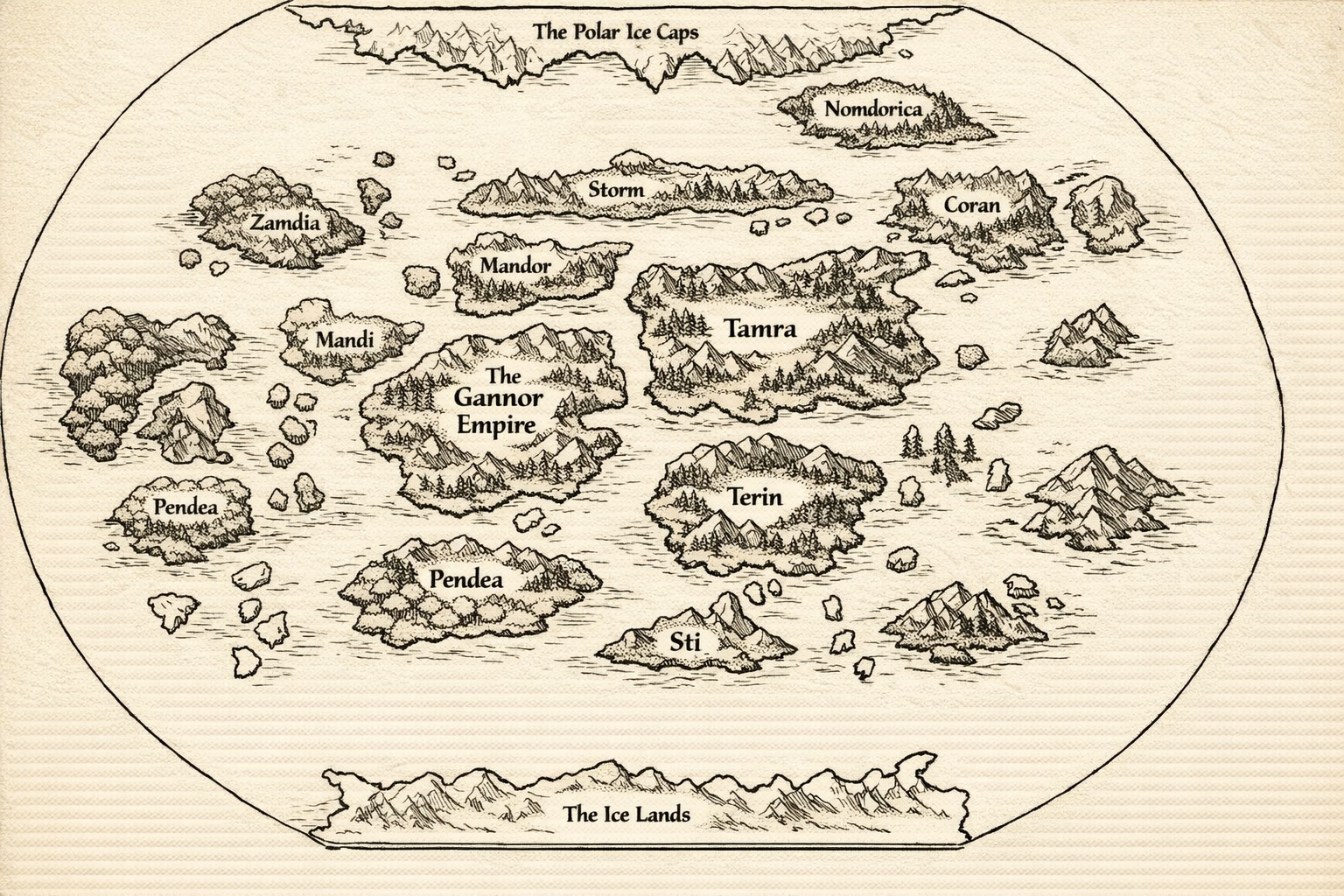
The Gannor Empire
The Gannor Empire is the most desolate land in all of Harthron. Its terrain is largely barren, stripped of nearly all vegetation save along the narrow coastlines where the salt air still carries some measure of life.
The region is one of barren hills, windswept plains, and a vast desert that tests even the hardiest of travellers. Yet despite these harsh conditions, Gannor produces two exports of note: fine olives and sweet wine, both cultivated chiefly in the coastal settlements where the soil has not yet surrendered to the dust.
The empire is founded upon slave labour and the strength of its legions, with the nobility deeply enmeshed in the slave trade. It is ruled by Emperor Hoglan Gannor from his seat in the capital city of Marn.
Law & Magic
Magic Regulation
All who practise the arcane arts must register with the Empire and render payment of one hundred gold pieces each month. Those who serve in the Emperor’s armies are exempt from these fees. The penalty for unlicensed spellcraft is severe: enslavement, or death.
The Dark Ones
Shadowy agents of enforcement who hunt down and destroy unauthorised mages throughout the cities of Gannor. Of their methods and their masters, little is known, and less is spoken aloud.
Marn
Overview
Marn is the greatest city upon all the face of Harthron, home to more than two million souls. It serves as the seat of power for Emperor Hoglan Gannor and stands as the beating heart of the empire.
The city is enclosed by distinctive walls of golden-hued sandstone rising fifty feet high, raised not against the armies of rival kingdoms but against the brutal sandstorms that sweep in from the surrounding desert.
The River Ninard
The River Ninard flows through the city from the north, and it is the lifeblood of Marn. Merchant vessels and barges ply its waters, and the river sustains the city’s inhabitants, their livestock, and the surrounding farmlands alike.
Government & Military
The Emperor’s grand estate occupies the heart of the city, a sprawling complex that serves as both the seat of governance and the royal residence. It is guarded by the Gannor Elite High Guard—two hundred and fifty decorated veteran warriors, the most honoured soldiers in all the empire’s legions.
Religion
Marn is the only city in all of Harthron that houses a temple to every god known to mortal kind. This is a reflection of Emperor Hoglan’s well-known unease at the thought of giving offence to any deity. The Church of Cordall maintains the largest and most prominent temple in the city.
The Raidhonda Coliseum
Standing west of the city walls, the Raidhonda Coliseum plays host to brutal gladiatorial contests each week, drawing audiences that exceed one hundred thousand spectators. The Church of Cordall oversees these games, in which criminals, trained fighters, and warriors drawn from across the world compete in mortal combat.
Law & Order
Magic Regulation
All who practise the arcane arts must register with the Empire and pay one hundred gold pieces each month. Those who serve in the Emperor’s armies are exempt. The penalty for unlicensed spellcraft is severe: enslavement, or death.
The Dark Ones
Shadowy agents of enforcement who destroy unauthorised mages throughout the cities of Gannor. Their methods and their masters remain shrouded in deepest secrecy.
Slavery
The empire is built upon slave labour and military might. The trade in slaves is widespread, and the nobility are deeply enmeshed in it.
Starmoon
Starmoon is a port city upon the southeastern coast of the Gannor Empire, and its recent history has been one of turmoil and blood.
Some ten years past, the people of Starmoon rose in rebellion, seeking to cast off the yoke of the Empire and declare themselves a free city within the borders of Gannor.
The uprising was crushed by the Emperor’s legions. In the aftermath, the city was placed under the governance of Governor Uvari Lalu, a retired officer of the imperial armies whose loyalty to the throne has never wavered.
Under Lalu’s iron hand, Starmoon has returned to order — yet the memory of the rebellion lingers still in the streets and taverns of the port, spoken of only in whispers.
Gontail
Overview
Gontail stands at the heart of the continent of Tamra, upon the shores of the Sea of Vir. It is renowned across all of Harthron as the greatest centre of trade and commerce in the known world. There is nothing that cannot be purchased in Gontail.
Architecture & Defenses
The city is built of distinctive stone, its skyline crowned with towers. Its great port was constructed by dwarves of the Rakk Mountains — master builders whose craft endures through the ages. The city is girded by walls of stone one hundred feet high, likewise wrought by those same dwarven hands.
Population
More than one million souls dwell within the sprawling city and its surrounding communities. Humans have long formed the greater part of the populace, but since the War of the Gathering, orcs and dragonborn now comprise a significant portion of both the city’s people and its guard.
Trade & Commerce
Gontail draws goods from every corner of the world and sends forth wheat and agricultural produce from the farms that surround it. Its central position upon the Sea of Vir renders it accessible from nearly every shore of Harthron.
Government
Gontail is governed by a mayor and city council. At present, the city remains under the dominion of Gurrainno, who seized it some fifteen years past in a siege that saw the city fall after only three days of aerial assault.
The Underworld
Randolf’s Ravens
The city’s thieves’ guild, known as Randolf’s Ravens, is said to maintain spies in every major port across the world and in most inland cities besides. Their network of informants and operatives is without equal.
Central Mandor
Of Highlocke upon the Blood River
In the eastern lands of Mandor, where the forests run unbroken for many leagues and the rivers are swift and cold, there stands a town of timber called Highlocke. It is not old, as the reckoning of kingdoms goes, nor is it great. Yet it has endured, and in those lands that is praise enough. It lies upon the banks of the Blood River, and the song of its saws and the thunder of falling trees are heard far off among the hills. Down the dark water the great logs go, bound for markets that the woodsmen of Highlocke have never seen.
Rich are the lands of Mandor in wood and stone and all the wealth of the earth, and many have coveted them. To the north the Northlanders hold sway: a hardy folk, fair of hair and hard of hand, who long ago put aside the axe of war for the scales of trade, though they have not forgotten how to lift it. Three hundred miles northward stands the city of Tepes. Far to the west lies Hoglan beneath the banner of Gannor. And in the mountains that rise to the east, the Dwarves have delved their halls since before the first tree of Highlocke was felled, and their trade runs through all that country like silver in a vein of stone.
Not long past, the Empire of Gannor, whose dominion spreads wide across the west, came eastward with its legions to take these lands for its own. But the Three Kingdoms stood against it, and the Wood Elves came out of their forests beyond New Gannor to stand beside them, and the Empire was turned back. Now it comes to Mandor with merchants rather than with spears. Yet a legion still keeps its watch in New Gannor, and the wise do not forget it.
Along the Blood River, peace is bought and not given. A lord of brigands named Kosovo has made himself a kingdom in those parts, and most of the river-towns pay him tribute so that his riders pass them by. Highlocke is not his, and does not name him lord. Yet it lives beneath his shadow and his protection, which in such times are much the same. Those who have dwelt long in Mandor know this well and do not speak of it lightly.
Men are the most part of the folk of Highlocke, though Dwarves dwell there also and keep their trading-halls. Goliaths and Dragonborn are seldom seen, and when they come there is staring in the streets, but no unkindness. The children, being bolder than their elders, follow the Dragonborn about with questions, for few in that town have ever beheld one of that people.
So it was in that season that strangers came to Highlocke. Varka of the Goliaths came, with Karrusk Deepfang and Edward Sicklexfoot journeying beside her. There came also a man of the Northlanders who had sold his farm and all that was his, and now served as a guard to a trader of the town. Of the others who would come, and of how their roads would cross, nothing yet was known.
And this also was held as law among the folk of Highlocke, and all who came there were bidden to heed it: that no fire be kindled carelessly, nor any spell of flame be wielded save where it might be mastered. For the forest was their life and their living, and a fire loosed among the trees would undo in a night the labor of a hundred years.
The Savage Legion
The legion that remains is known as the Savage Legion. Composed mostly of humanoids and orcs, it now engages in trade.
The Blood River
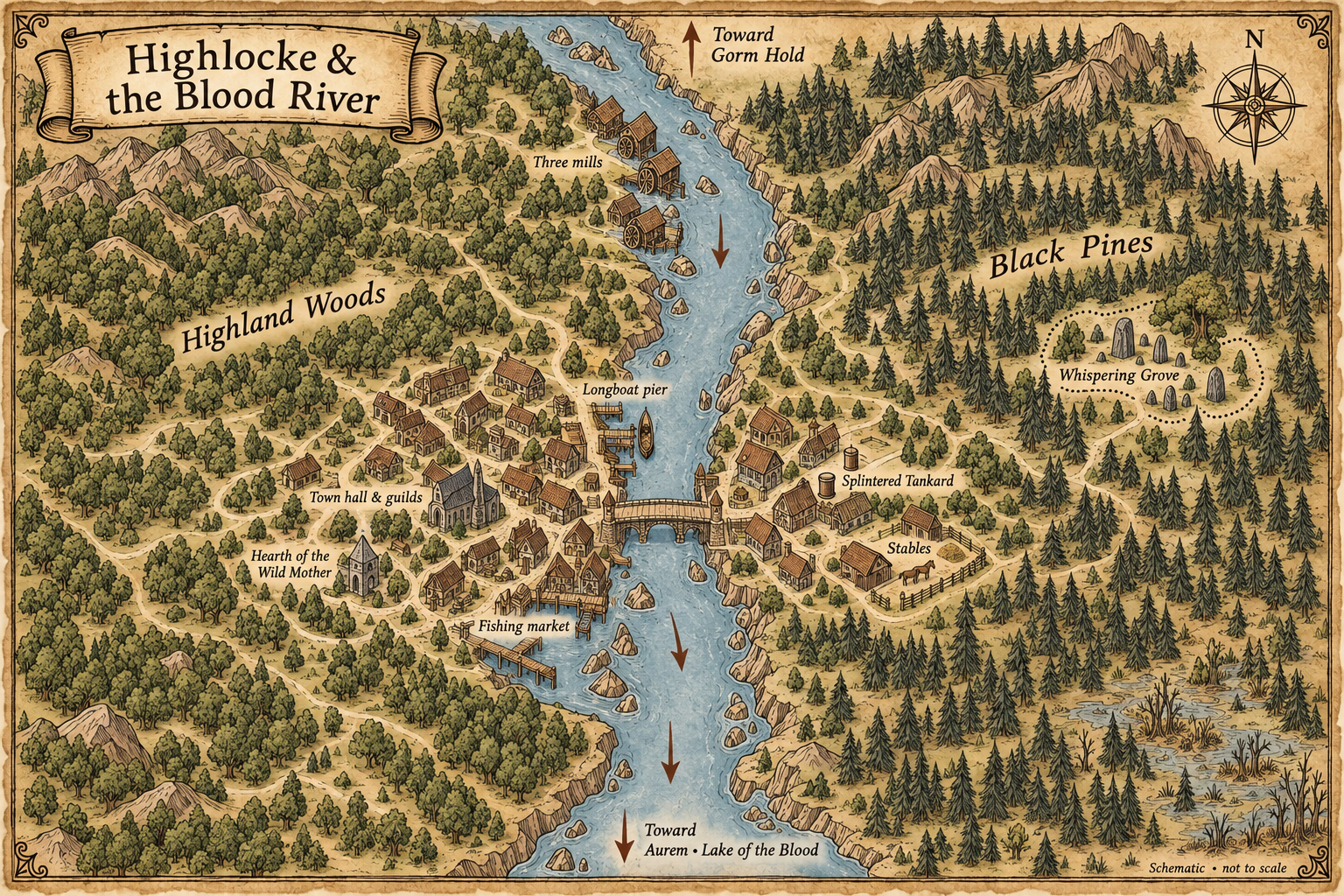
The Blood River flows south from Gorm Hold to Aurem, a city on the Lake of the Blood. It carries trade through a region whose settlements depend on moving heavy timber.
Local stories offer different explanations for the red water. One tells of a gold dragon who loved a human woman and whose tears colored the river. Another speaks of Ella Merman, a wizard, vampire, and warrior mourning a mortal woman. The stories disagree, and the river keeps its color.
Highlocke
Most business takes place on the western bank, where the town hall and guilds stand near the fishing market. The longboat pier lies just north of the bridge. The lumber guild runs Highlocke, led by Thorgar Stoneshield. Far north along the western bank, three mills process the timber; one is run by a goliath whose brother leads a logging crew.
Maeve Two Fingers owns the large Splintered Tankard tavern and runs the eastern side of town, where the tavern and its stables stand. Her name remembers two lost fingers, leaving eight. She once fought a treant and served as a scout for the town. Her tavern is a place to seek news of travelers and the surrounding country.
Timber and the forests
West of the river, the Highland Woods provide ironwood prized for shipbuilding. Its strength has also found use in a road in Gannor built from the wood. To the east stand the Black Pines, whose timber is said to resist fire. Both forests are thought to hold magical properties.
The Moorsmen patrol both forests under Gerrick, a human ranger. Orin, also human, captains Highlocke's town guard.
The Hearth and the Grove
The Hearth of the Wild Mother is a stone church of Stellina, goddess of the Hunt. Malthus, an aasimar cleric, leads the Warden of the Iron Wood there.
Elara leads the small druid sanctuary of the Whispering Grove, east of the Blood River. Its druids are generally on good terms with humans and loggers, but Elara fears that logging deeper into the woods may provoke fey or trolls. Trolls are reported to be coming out of the Black Bog Swamps, and loggers in the Black Pines have encountered more humanoids. The possible resistance of fey in the Highland Woods remains a concern.
East Mandor
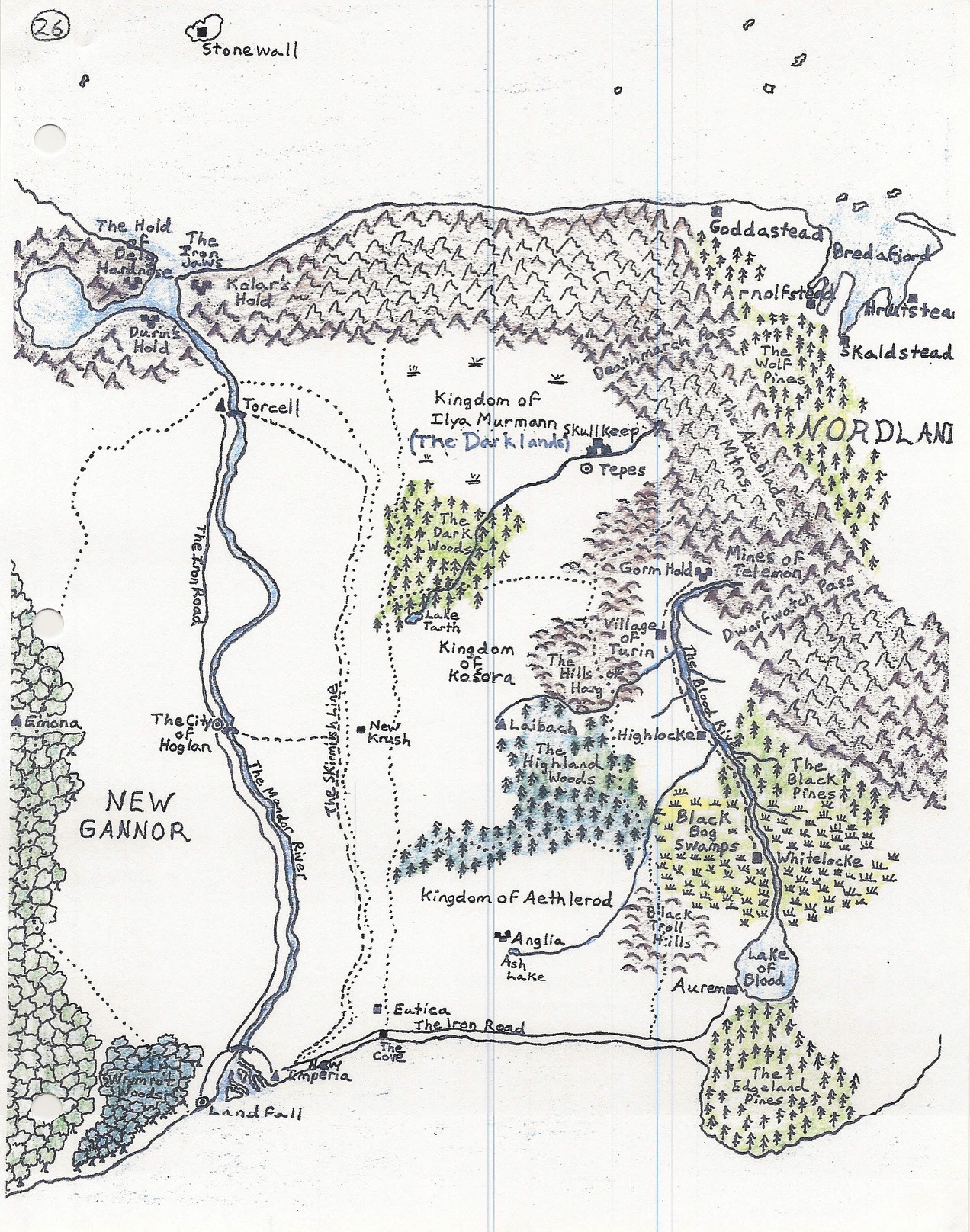
Looking for the full world outline as well? Visit the World Map.