The Shrouded Isles
6 Chapters · Vegas Campaign · Astral Plane · Velmora
Chapter I
The Bargain of Zdomir
In a private chamber above the common noise of the inn, where the shutters were drawn and the candlelight lay low upon the table, the company was summoned before a man who named himself Zdomir. The room had the dry smell of old boards, travel-cloaks, and extinguished incense, and beneath an area rug, half-hidden from careless eyes, lay the chalked and silvered lines of a magic circle. It was the sort of chamber built for confidence, treachery, or both.
Zdomir was human in seeming: long-haired, green-eyed, and clothed not for war but for travel and wary business. No sword hung at his side, nor mail upon his breast; yet there was about him the guarded stillness of one who had long dwelt near peril. He spoke with the restraint of a man who had rehearsed every word and feared the cost of adding one more.
There Zdomir made his offer. He would speak now, he said, and answer what questions he deemed safe. But once the company departed and set foot upon the road of the mission, no sending, spell, whisper, charm, or messenger would reach him. The path ahead would be long, strange, and perilous; a work fit only for those who had already made peace with danger. Most sensible folk, he admitted, would refuse it.
The Stone
The task was simple in its telling and dark in its doing: recover a stone. It was no larger than a fist, and yet Zdomir spoke of it as men speak of things buried deep in the heart. When pressed as to its power, he would not say. When asked what he meant to do with it, he answered only that it was of great importance to him.
Zeg, watching him closely, perceived that this was no mere hunger for a weapon, nor the covetous gleam of a merchant after a jewel. Whatever the stone was, it touched some hidden grief or memory in Zdomir. The man’s hands remained steady, but his silence did not; it gathered around the stone like a shadow around a covered lamp.
The stone could not be reached by common road. It lay not merely beyond mountains or seas, but upon another world. No teleportation could take them straight to it. They must pass instead through the Astral Plane, seek out a color pool, and from there enter the world where the stone was kept.
The Way Through the Astral Sea
To guide them through that strange middle-realm, Zdomir had arranged a contact named Veil. Another man, Thran, would meet them on the following day and plane shift them to the place where Veil awaited them. From there, if fortune held, they would find the proper color pool and pass onward.
But even then the way would not be open. The stone lay in the hoard of a powerful collector, a being whose name Zdomir either did not know or would not speak. The collector was said to possess a vault of wonders and relics, and to guard them with such secrecy that even the smallest scrap of knowledge had been hard-won.
The vault was upon the Shrouded Isles: islands easy enough to name, perhaps, but hard beyond reason to reach. They were veiled in obscurity, and only the locals knew the way. Those locals, it seemed, were pirates. The word hung in the room a moment, half warning and half invitation, and more than one face at the table changed in a way that suggested Zdomir’s caution had not had precisely the effect he intended.
The Sealed Pouches
The company would each receive a sealed pouch, marked in wax. Some pouches would contain only fragments of information. One would bear the true description, perhaps even the image, of the item sought. These were not to be opened until they reached the Shrouded Isles.
If any were captured, the pouch was to be destroyed: burned, torn, cast into the sea, or ruined by whatever means lay nearest at hand. Better that the message be lost than that the collector learn the true object of their search. Zdomir’s fear was plain. If the collector believed they sought only some unnamed prize from his vault, then perhaps the stone might still be recovered. But if he learned that Zdomir sought this one particular thing, the chance would be lost forever.
The Questions of the Company
Crowe asked what manner of power this collector held. Was he a mighty spellcaster? A lord of assassins? A warrior whose name made cities bolt their gates? Zdomir confessed he did not know. He knew only this: the collector was powerful enough that one missing item might go unnoticed for a time, but if the company plundered half the vault, they would earn a hunter for the rest of their lives.
This warning did not have quite the discouraging effect intended. Zeg pressed him hard. Why should they go blind into another world for a stone they could not see, held by an enemy they could not name, on islands they could not reach without pirates? Was this a just quest, or merely theft dressed in finer words? Was the world in danger? Would the stone be used for the greater good?
Zdomir would not unveil the whole matter. Yet he swore that the stone would not be turned against the greater good, and that there was more at stake than greed. Whether his justice and theirs were one and the same, none could yet say.
The Bell and the Striker
The payment was set at twenty thousand gold. Ten thousand would be paid in advance, and ten thousand more upon delivery of the stone to Zdomir. The first purse was divided among the company, 1,250 gold each. Yet even this glittering sum did not quiet all doubts. Zeg judged the reward too small for the danger.
Still, treasure was not the only lure. There would be the Astral Plane, the color pools, a hidden world, pirates, and the Shrouded Isles. Adventure has its own bitter coin, and some hearts spend it gladly. Then Zdomir placed upon the table a bell and its striker.
“This,” he told them, “is your only way home.”
Zeg took it up and studied the sigils upon bell and hammer. The craft was planar, and the striker seemed to serve as a key, attuned to Harthron. It would not return them neatly to the doorstep of the inn, but it might bear them safely back to their home plane, somewhere within a known region rather than into fire or void. It was not comfort, but it was a road.
The Morrow Appointed
Lisander considered more practical matters. Once returned to their own plane, teleportation might bring them back to the city, if they could reach or remember a proper circle. The company therefore made plans to visit a magical academy, pay for access to its teleportation circle, and study its marks well enough that Lisander could guide them home when the time came.
Kest, seeing that doubt could circle forever like a hawk over carrion, brought the matter to its edge: were they going, or were they not? Some named the plan terrible. Others admitted they had followed terrible plans before. In the end, the answer came as such answers often do among adventurers: not with certainty, but with fellowship. They would go.
Zdomir instructed them to return on the morrow to the same chamber. The innkeeper would lead them there, and Thran would await them. No additional companions were expected. If they wished to bring chickens or a horse, Zdomir did not forbid it, but he warned them that the Astral Plane was no place for livestock.
“The Astral Plane,” he said, “is a place between places. A backstage to the universe.”
Thus the bargain was struck. Afterward, the company turned to preparations. Money was counted. Supplies were considered. Ink for teleportation circles was discussed. The academy’s circle was studied and committed to memory, and the smaller business of adventuring followed after: who among them could see in darkness, who could not, and how much one ought to pay for Goggles of Night.
The search for such goggles led them into the magic shops of the city, where bargains proved as treacherous as astral currents. A first shopkeeper was unmoved by poor persuasion, dubious claims of friendship, and offers of music. Prices were weighed, healing potions haggled over, and the party discovered, as many heroes have before them, that merchants may be more dangerous than monsters when gold is newly in hand. There was talk of another shop in a darker quarter, one known to thieves and sellers of goods “slightly used.” Gerrik found the distinction between “used” and “stolen” worth naming. Brynja, though sparing of words, remained with the company as preparations carried on toward morning.
So ended the first day of the bargain: with gold in purse, doubt in heart, a bell for the homeward road, and before them the vast unseen way.
The Vegas campaign opens with a commission deliberately short on answers: a stone, a collector, sealed pouches, and a road through the Astral Plane.
Zeg immediately pushes the moral shape of the job, which gives this campaign a useful tension before anyone has even left the room.
The bell and striker establish the campaign’s survival problem: the party can leave Harthron, but returning cleanly is never guaranteed.
Chapter II
Into the Silver Void
When morning returned to the inn, the bargain of the previous day had not grown fairer in the light. Yet the company came again to the chamber above, where the work had first been spoken, and there they found Zdomir waiting with a half-elf named Thran.
Zdomir had not meant to come, or so he said; yet some words had lain ill with him overnight. He wished the company to know that the payment was not small because he held them cheaply. He was but one man, and this was what he could gather. But when the stone was known for what it truly was, he believed the company would judge the work worth the peril. He spoke again as one whose heart was bound to the thing sought, though he still would not name the bond.
The company pressed him with questions before the road was closed behind them. There might be a decoy stone, or there might not. The stone could be destroyed, though Zdomir begged that it not be destroyed unless all other hope was lost. The world beyond the Astral Plane was called Velmora, and the company’s destination there remained the Shrouded Isles. Veil, their guide, was an elf, though no sign or counter-sign was given. The sealed pouches were still to remain unopened until the Shrouded Isles were reached.
Thus were the last answers given. Zdomir withdrew from the path before it truly began, and Thran took up the work for which he had been paid. In his hand he held a piece of metal: a tuning fork, wrought for the Astral Plane. He began to cast, and the chamber, the inn, and the known world were torn away.
The Silver Dark
The passage was violent: not a step through a door, but a wrenching of body and spirit, as though unseen hands had seized each soul and dragged it backward through the skin of the world. Yet the sickness faded almost at once.
Silence followed. Not the quiet of night, nor of snow, nor of an empty hall, but a stillness older than air. Around the company stretched a measureless dark, veiled in silver mist. Broken stones and old ruins drifted there, some turning slowly, some wandering away into depths where no horizon lay. From time to time pale lines flashed in the distance, silver and perilous.
There stood Veil. He was elven, though not of any woodland court the company knew. His skin was grey as ash; his features pale, keen, and unsmiling. Black hair was tied loosely behind him, and his dark eyes seemed to look upon two things at once. He wore black studded leather beneath a hooded cloak, carried a worn traveler’s pack, and bore two short swords and a heavy crossbow. He knew none of their names, and preferred it so.
Veil’s bargain was plain. He was a guide, not a shield. If battle came, he would flee, hide, or vanish, and if the company survived he would return. He warned them not to touch the silver lines that sometimes crossed the Astral dark, for such things were not meant for stray hands. He warned them also not to cast away anything they wished to see again.
Before setting out, Veil made the company learn the first law of the place: motion was not merely of foot and sinew, but of thought. Where there was stone beneath them, they might stand. Where there was no stone, they must remember how to mean themselves forward. He set them first to simple trials: a leap to a still object, then a leap to a stone that drifted and turned. Most managed well. Crowe nearly missed his mark and caught the edge by narrow fortune. Halvar proved unexpectedly adept in the rescuing of those whom the void had made foolish. Kest and Crowe did not master the art at once, and so rope and caution became their friends.
The Astral Plane is introduced less as scenery than as a new rule set: motion, danger, and even silence have to be learned again.
Veil is useful but not heroic. His promise to guide without shielding the party tells the players exactly how alone they are.
The early movement trials make the later fights feel earned, since the party has already discovered that direction itself can become a problem.
Chapter III
The Void Maw
They had not gone so far as to forget fear when the mist began to move strangely behind them. It was Kest who first saw it: a shape long and impossibly dark, gliding not like a bird, nor like a drifting stone, but swimming through the silver haze as some deep thing swims beneath the sea.
The company glimpsed coils black as oil and streaked with silver like moonlight on water. They saw a circular maw large enough to swallow a horse, rimmed with inward-curving teeth. Behind that horror drifted long tendrils, feeling at the void like the antennae of some monstrous thing from the abyssal sea. Then it slipped away again, and the mist swallowed it. Veil named it only as an astral predator. He counselled against rash attack, but soon the creature appeared behind them again, closer now, certain in its hunger.
“It is stalking us now.”
Zeg answered with lightning. A bolt of brilliant wrath tore through the silver dark and struck the creature’s length. For a moment it seemed to recoil and withdraw, its black coils vanishing into haze. But this was no victory. It was only the first wound. Veil vanished.
The monster returned with dreadful suddenness. The mist collapsed inward, darkness erupted, and the vast mouth struck at Zeg. Teeth closed. The wizard was swallowed into living night. Within the beast he was blinded, bound, and carried through the slick dark of its throat and belly. Yet he did not surrender to it. From inside the creature, Zeg gathered storm and loosed another lightning bolt through flesh and hunger. The Void Maw shuddered. Silver-black muscles convulsed, and it spat him back into the open void.
Then battle broke loose in all directions at once. The Void Maw streaked through the company like a living battering ram, throwing bodies sideways through Astral space. Its psychic tendrils lashed at Tavin, and a tremor of mind and terror rolled outward from it, filling brave hearts with sudden dread. Lysander met that fear with song-born magic, wrapping courage around himself and bending beguiling power toward the beast. With the authority of a tale-commanding king, he bade it halt.
Kest fought to right themself amid the tumbling void, closing with the monster when others might have drifted helplessly away. Crowe struck it with eldritch force, then later raised a wall of fire along its vast body, searing the black coils in flame. Tavin called forth a fey spirit, bright and fierce against the dark, and the spirit harried the thing with uncanny blows. Halvar, spun and battered by the strange laws of the plane, mastered himself, held fast to rage, and drew Zeg back toward his side when the wizard stood exposed before the maw.
The beast burned in the walls of flame. Its movement faltered. Its hunger became agony. At last Lysander’s fire took it. The Void Maw twisted in the silver dark, its great coils writhing, and then the life went out of it. From its corpse the company took three shield-sized scales, jet black and veined with silver like lightning trapped in stone, and a short-sword-sized tooth from the smallest of its hooked fangs. Such trophies might one day be of use to a smith, perhaps for a shield or warding craft tied to force. When the harvesting was done, Veil returned, or at least allowed himself to be found again.
The Void Maw works as a first astral predator because it attacks the party’s assumptions about space, formation, and rescue.
Zeg being swallowed and blasting the creature from within gives the fight a clean mythic image.
The harvested scales and tooth give the victory a material consequence that may return later at a forge or bargaining table.
Chapter IV
Still Point Keep
At length Veil’s face hardened, and he pointed ahead. Through the mist there loomed a ruined black fortress set upon a vast triangular mass of earth and shattered stone, as though some god had cut a keep free from another world and set it adrift forever.
This was Still Point Keep. For a place filled with travelers, it was terribly quiet. Lanterns burned along walls and chain-linked bridges. Figures moved upon the battlements and in courtyards. Yet no tavern roar, no market cry, no hammer-song of ordinary settlement carried into the air. Even before they entered, the company felt that the silence was not custom. It was law. Perhaps more than law.
“The one who keeps order here is called Morevein, the Keeper. The keep survives because people understand when to be quiet.”
Veil warned them to keep their voices low, speak only when need demanded, and draw as little attention as possible. Still Point was safer than much of the Astral Plane, but safety there was a narrow bridge over deep water. To find the color pool to Velmora, Veil needed an astral vector, and only one in the keep could provide it. That one would meet only with two. Veil chose Zeg and Lysander. The others were sent to wait at The Quiet Cup, a tavern-like tea house beside an arena roofed with black chain.
Maeloc, Keeper of Prices
Veil led Zeg and Lysander along the side of Morevein’s inner keep. There the black walls rose like cliffs of midnight stone, and the stillness grew heavy, pressing behind the eyes and along the skull. Armored figures watched without motion from above. Breath itself seemed too loud. At last they came to a door marked with the name Scholar Maeloc.
The archive within was immaculate. Each shelf stood precisely aligned; each scroll tube bore its fine label; no dust lay anywhere. It did not feel like a shop, nor like a scholar’s cluttered room, but like a device built for the storage and exchange of knowledge. Maeloc came forth: a githyanki scholar, yellow-skinned, freckled, and unreadable. Veil named the need plainly: an astral vector to a color pool leading to Velmora.
“Fifteen thousand gold.”
Zeg had no such purse to spend. Maeloc offered another payment.
“A memory.”
He looked first upon Zeg and seemed puzzled, as though the desired coin was not there. Then his gaze moved to Lysander. The price became sharper: the memory of Lysander’s dearest friend. Lysander hesitated, for the matter touched his lute and the stories bound to it. Maeloc made clear that he did not want the instrument, nor the stories of the instrument. He wanted a true memory. At last Lysander agreed, and before the rite he gave Zeg a scroll of stories, to be read back to him if some treasured part of himself was taken beyond easy return.
Maeloc brought a shallow bowl filled with cloudy liquid like watered mercury, a long silver needle, and a spool of pale thread. When Maeloc held it, the needle grew translucent, almost spectral. Lysander sat. Maeloc touched the needle near his ear and bade him think upon his most cherished friend. The needle vanished slowly into Lysander’s head. No blood followed. The thread trailed from him to the bowl, glowing faintly while the memory was drawn out. The silver fluid shrank, hardened, and became a coin. When it was done, Maeloc departed and later returned with a delicate spherical cage of dark silver bands, holding at its center a jagged translucent crystal that spun and tumbled without touching its prison. This was the vector. It would lead them to the nearest color pool bound for Velmora.
The Quiet Cup
While Zeg and Lysander dealt with Maeloc, the others entered The Quiet Cup. Warm lantern light spilled across polished dark stone. The room was full, but subdued almost beyond belief. Travelers sat over steaming cups, speaking softly or not at all. Some voices came first as thoughts rather than sound. A hobgoblin server named Pell, missing his left hand, greeted them and guided them inward. Other servers moved through the room as well: elves, and a heavily scarred human.
There was no beer, no mead, no drunken roar. There was tea. Its scents hung in the room like small enchantments, each cup carrying a promise that seemed too delicate to name aloud.
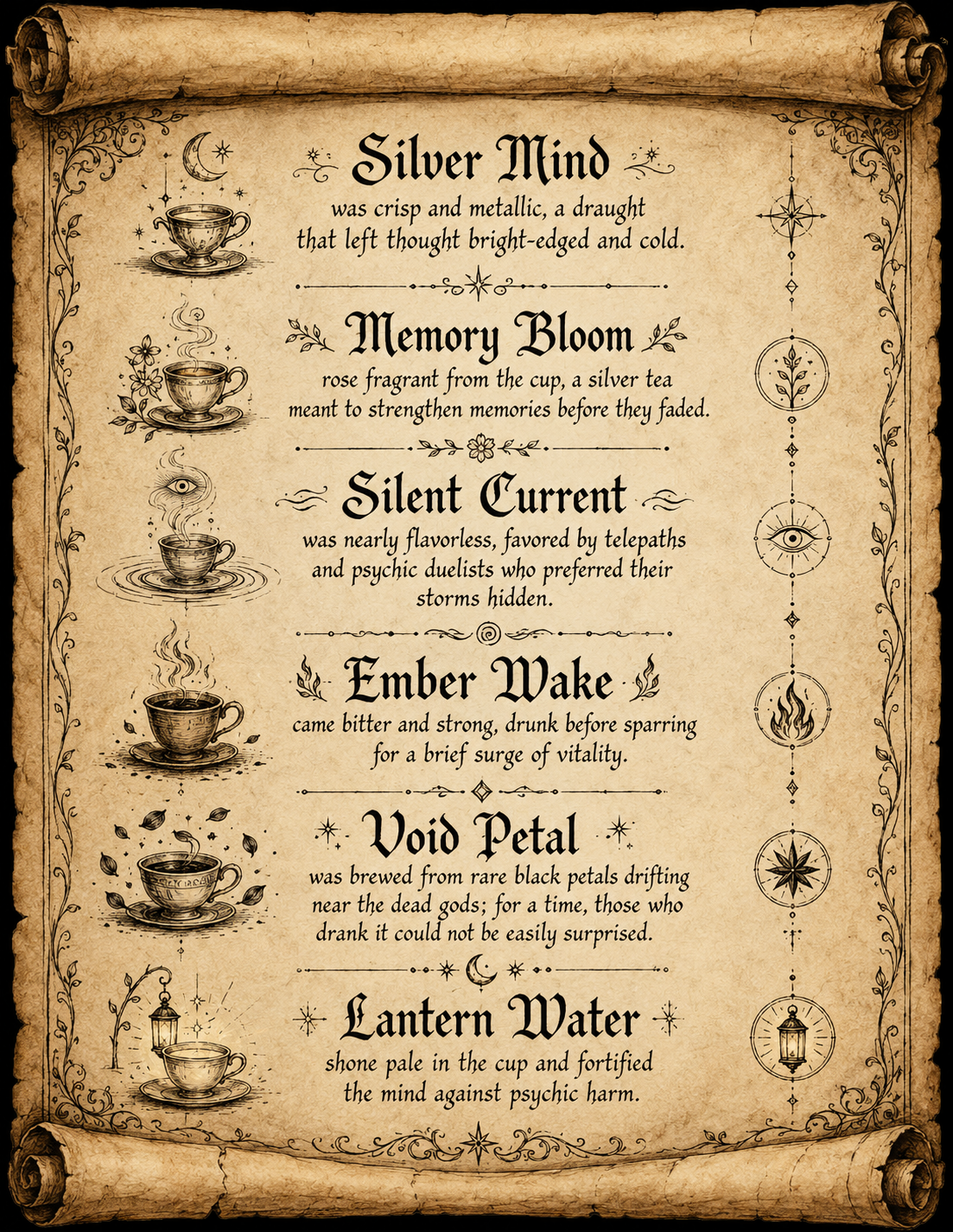
Beyond a doorway lay the sparring yard. There, beneath a dome of thick black chains, warriors trained above the endless silver void. Blades flashed, psionic force crackled, and bodies fell, yet almost no one cried out. The only sounds were controlled breath, scraping boots, and the carefully measured strike of steel. A deep gnome with a wooden practice sword defeated a githyanki sparring partner, then turned his grin upon the newcomers. He baited Halvar with barbed words about dwarves, mountains, ale, failure, and old songs. Halvar did not answer with axe or fist. He poured water over the gnome’s head and walked away, leaving wrath unspent and the Keeper undisturbed.
When the company had rested a little and recovered what strength could be recovered in a place where time itself seemed uncertain, Veil advised them that if they needed anything more, they should seek it now. They passed into the merchant quarter, where potions could be found at Mother Selvine’s Potion Shop and blades could be repaired at J. Droken’s Forge. The smith was a grey-skinned duergar who seemed to have been carved from the same dark stone as the keep itself.
“If you’re here to watch, leave. If you’re here to buy, get out your coins.”
The company showed interest in what might be made of the Void Maw’s scales, though such work was no simple matter and perhaps not work for that forge. Talk also turned to hooked javelins and harpoons, tools for a party that had learned the terrible value of ropes in the Astral dark.
Still Point Keep changes the danger from teeth and fire to attention, etiquette, and cost.
The memory bargain is a strong campaign hinge: the party gets the road onward, but the cost lands inside a character rather than on a ledger.
The tea house and sparring yard make the keep feel lived-in without breaking its central law of controlled silence.
Chapter V
The Ruined Visage
With the vector in hand and Still Point Keep behind them, the company went once more into the silver emptiness. How long they traveled, none could later say. In the Astral Sea, hours had little purchase, and distance was a thing half-measured by will.
At length the mist thinned, and shapes gathered out of the void. Broken columns lay scattered across a dead landscape. Great slabs of stone hung motionless above the ground. Ahead rose a broad and gentle hill, and beyond it, almost lost in the distance, a weathered arch of pale stone stood against the dark. To one side a steep cliff climbed upward, crowned by rows of petrified trees, black and still as spears planted for the dead. The air seemed to remember a wind that had not blown there for ages.
Veil narrowed his eyes. The pool, he said, should be somewhere near. Yet between the company and the arch there lay a ruin, and ruins have ever been a snare for those whose hearts are curious. Some wished to go straight to the arch and leave old stones alone. Others could not pass so near to forgotten work without looking upon it. So Kest, Brynja, and Tavin descended toward the fallen building while the others watched from above.
The Ruined Visage
The ruin gave up little at first. Kest and Brynja found dust, stone, and the stubborn silence of ages. Tavin, looking more carefully, saw that the place had not been merely shattered by chance. It had been abandoned long ago, and whatever had once been done there had ended in sorrow, not haste. Symbols lay half-worn upon stone. Fragments of old patterning clung to pillars and thresholds. The company called for Garrick, and when he came down among the stones, he read more in them than the others could. This had been no mere house, nor watch-post, nor fallen hall. It was a place of rite, ancient beyond easy reckoning.
Then the trees moved. From the petrified copse above the ruin, five githyanki descended like knives dropped from a black hand. They came swiftly and without warning, their yellow faces hard and their blades already drawn. They had waited until the company was divided; then they fell upon the smaller group below.
The Ambush Beneath the Trees
The first stroke of the ambush was cruel. Tavin was struck again and again, steel biting with a second pain behind it, as though the wound reached into thought itself. Garrick was cut as well, yet he answered with battle-prayer: a spiritual weapon sprang into being beside him, and thorned magic lashed outward to drag pain back upon the attackers. Crowe, seeing the peril, tore space apart and stepped through it, arriving in the battle by a door no wall could bar. Brynja met the attackers with heavy blows, breaking their stance and driving one down. Halvar came raging into the ruin, the strength of the World Tree seeming to reach through him, and with great sweeping strikes he wounded and cast down more than one foe.
The githyanki did not fight like common raiders. Their heads turned as if hearing commands no mortal ear could catch. Then some vanished in pale steps of magic, reappearing beyond the company’s reach. From the hill above, a red-white sphere of fire descended and burst among the party. Flame washed over stone, armor, owl, and flesh. Most endured it; Brynja bore the worst of the blast. Then came the greater threat. A floating boulder hurled itself toward Halvar, smashing near him, and behind it descended a githyanki champion bearing a great two-handed silver sword. The blade shone with a beauty that was not of mercy.
Garrick answered with a sudden storm of steel, crossing the field in bright and deadly strikes. Crowe turned his will upon the sword-bearer and hammered him with eldritch force. Brynja closed with the champion, struck him down, and with fire and fury ended him. Halvar, seeing Tavin hard-pressed and hurt, poured healing into him and drew him by the living strength of the World Tree into shelter near his own side. Kest entered the fray and finished one of the wounded gith. Tavin, restored enough to act, set bow and companion against the fallen enemy. Zeg, who had watched the trees with a wary eye, marked that more githyanki lingered hidden among the branches and moved at last toward the field.
The fight ended not with surrender, but with the githyanki broken, slain, or vanished back among the trees. The ruin grew still again. Yet the company knew now that the place was watched, and that the victory had not erased the eyes in the wood.
The Silver Sword
Among the fallen lay fine armor worked with intricate detail, weapons of careful make, two magical bottles, and a small enchanted stone. But one thing drew all eyes: the silver greatsword of the champion. Veil returned and saw the blade. His warning was immediate and grave. The sword was no ordinary treasure. To the githyanki such a blade was sacred, and they would cross the universe to reclaim it. It might be useful in the Astral Plane, he admitted, for cutting the silver cords that bind some travelers to life; but to carry it away would be to summon a hatred without end.
The company chose caution, and perhaps honor. They returned the sword to the line of petrified trees from which the ambushers had come. Then a message was sent into the unseen dark.
Waylaid by your sword-bearer, we fairly slew him. We returned the silver blade where you came forth. We seek no war, yet stand ready.
No answer came. The other discoveries were gathered with less ceremony: magical bottles later known as a potion of superior healing and a potion of speed, a sending stone taken from the githyanki dead, and armor worked with the severe craft of that people. Yet the blade left behind mattered more than the prizes carried away, for it marked the boundary between victory and folly.
The party could have ignored the ruin, which makes the ambush feel like a consequence of curiosity rather than a mandatory stop.
The githyanki attack lands because the party is split, turning the environment into part of the encounter design.
The silver sword is useful enough to tempt the party and dangerous enough to punish greed.
Returning the sword marks a different kind of victory: they choose not to make an enemy merely because they can profit from one.
Chapter VI
The God’s Tear
The Mourning Visions
As the company searched the field and the old stones, the place began to speak, not in words, but in memory. Brynja saw a gathering of human mourners before a religious ceremony. A dark cloth covered a holy sign, and grief lay over the crowd like a shroud. Lysander saw the mourners also, and knew the vision was no wandering fancy of the mind.
Kest saw more. In one vision, thousands of people carried candles through the streets of a great city beneath a darkened sky. No voices rose; no bells rang; only the quiet light of mourning moved toward a vast temple. In another, Kest stood again within that temple. The candles had burned low. The altar was abandoned. The black cloth remained.
The truth slowly took shape around them. The ruin was not merely built upon holy ground. It rested upon the remains of a dead god. The cliffs, the hill, the trees, all were features of a colossal face half-buried in the Astral waste. The petrified trees were like lashes or brows about the eye of a divinity whose worshippers had mourned at the end. Here the Astral Plane showed itself as it truly was: the graveyard of gods.
The Arch and the Tear
Brynja passed beneath the ancient arch. The world faded. For a moment she stood beneath unfamiliar stars. Before her rose the same arch, new-built and untouched by time. Priests gathered in silence around it. Upon every arm was bound a strip of black cloth. Every face bore grief beyond speech. No prayer was spoken. No hymn was sung. They watched.
Then from the darkness above, through stars and through eternity, a single tear fell. It struck the stone before the arch, and light burst outward. The mourners fell to their knees. The vision shuddered and broke.
When Brynja came again to herself, the arch stood weathered around her, and beyond it the ground dipped away. There, hidden until one stood near enough to see, waited the color pool: an oval of impossible light, its surface swirling in bands of emerald, sapphire, gold, crimson, and violet. This was no mere gate. It was the place where a god’s final tear had fallen.
Veil would not cross beneath the arch. He walked only to its edge and around its perimeter, confirming with the vector that this was indeed the pool to Velmora. The road he had been hired to show was now before them, but he would not walk it.
The Buried Box
Before entering the pool, Tavin and Zeg noticed a mound of earth that did not belong. The soil had been disturbed, and beneath it lay a small metal box, ornate with religious markings. It bore no lock.
Zeg opened it with care. Within were ceremonial jewels, two golden mourning masks marked with tears, and a holy symbol shaped with the sign of a river. These things had not been hidden as treasure. They had been buried as devotion. The company chose not to take them. They returned the masks, the jewels, and the river-symbol to the box, set it once more into the earth, and buried it deeper and better than before. In a place where a dead god’s grief had become a doorway, some offerings were not theirs to claim.
Velmora
At the threshold of the pool, Veil gave the vector compass into Lysander’s keeping. Its magic, he warned, would die once it left the Astral Plane. It had served its purpose; beyond this point the company would have no guide but its own judgment.
Halvar entered first. He did not feel the same violent tearing that had brought them to the Astral Sea. This crossing was gentler, like sinking through water in a dream. The silver dark faded; cold closed around him; light shimmered above. One by one the others followed.
The company emerged underwater. For a few heartbeats there was only cold and light. Then they swam upward and broke the surface into day. They had come into a small lake, or a pond larger than a pond, set amid a forest. There was no arch behind them, no Veil, no silver mist, and no visible road back. The bell and striker were now their promised way home.
They reached the shore quickly, wet and wary. Tavin studied the magical things taken from the githyanki and named them: a sending stone, a potion of superior healing, and a potion of speed. Then he climbed a tree and looked out over the green world into which they had fallen. In the distance he saw smoke. His owl flew ahead to scout, and when it returned the signs were clear enough: there were people nearby.
The company followed. After a short journey through the woods, they found a road, and beyond it the coast. A small fishing village stood there without walls, with boats upon the water and a road leading quietly through. One larger vessel, more a modest trader than a warship, lay at anchor near the shore. Nets dried upon poles. Salt stiffened the ropes. Smoke rose from low chimneys and vanished into the sea-wind. The place seemed ordinary, and therefore dangerous in the way of all ordinary places that sit at the edge of a secret.
Thus the company came at last to Velmora, not by port or gate, but from a god’s tear into cold water and daylight. The Shrouded Isles still lay somewhere beyond them, and the pirates who knew their road had yet to be found. Behind them was the silver void; before them, the green shore and the first human voices of an unknown world.
The mourning visions turn the ruin from a battleground into a grave, which changes how the later buried offering reads.
The color pool being born from a god’s final tear gives the planar gate emotional weight instead of making it a simple transport device.
Leaving the buried devotional objects behind keeps the party’s conduct aligned with the holiness of the place.
Velmora arrives quietly: water, forest, smoke, road, coast. The Shrouded Isles are still ahead, but the campaign has crossed its first great boundary.
The Sunless Citadel
13 Sessions · The Yawning Portal · Pendea
Chapter I
The Gathering
It was in the grey twilight of autumn, when the dying leaves of distant kingdoms seemed to mirror the fading hopes of those who dared seek fortune in the perilous places of the world, that six souls of mingled virtue and corruption did gather within the Yawning Portal tavern. This establishment, famed throughout the realm as a refuge for adventurers of dubious repute, stood as a threshold between the ordinary world of merchants and scholars and the dark places where gold and glory awaited those mad or desperate enough to seek them.
The tavern itself was a den of shadow and amber lamplight, its rafters thick with the smoke of a hundred pipes, its floors worn smooth by the boots of a thousand wanderers. At its heart lay a great well, descending into darkness so profound that few who peered into its depths returned unchanged. It was here, beside that yawning abyss, that the six began to know one another.
The company was strange and unequal in temperament. Thorn, a soul of uncommon righteousness, stood apart from the others—a warrior of the Old Faith, chaotic in his devotion to justice, his eyes burning with the light of one who knew the difference between law and good. The others, by contrast, were creatures of shadowed purpose. Zazriel carried himself with the grace of one born to power, his secrets locked behind an enigmatic smile. Erebus, a scholar-mage, whispered in arcane tongues and seemed ever plotting some subtle scheme. Elle, swift and silent, wore the aspect of one accustomed to taking what the world would not freely give. Sasku, unpredictable and prone to violence, laughed at the wrong moments and fell silent at the wrong times. And Dar—who would join them later, though for now his grave remained as yet unexcavated—was as yet unknown to the assembly.
Their purpose was singular and grave: to descend into the Sunless Citadel, an ancient fortress that had sunk into the earth in ages past, now resting beneath the rugged peaks and twisted valleys of the far continent of Pendea. There, amidst terrain so harsh that even the hardy folk of the borderlands spoke of it in whispers, the Knights of Koth waged an endless war against the elder evils that infested its depths. But it was not the Knights who had hired this company, nor the war itself that drew them forth.
Rather, it was a mystery: the vanishment of the Green Dragon Guild, a fellowship of six adventurers of some renown, who had descended into the Citadel a month prior and sent no word. Either they had perished in its depths, or something far stranger had befallen them—and the Guild Masters would pay handsomely for proof of either fate. Thus bound by mercenary interest and the hunger for glory, the six swore their oath before the innkeeper of the Yawning Portal, drained their cups, and set forth on the long road to Pendea.
By roads winding through forests grown grey with age, and across plains where the wind seemed to carry the voices of forgotten peoples, they journeyed until at last the mountains rose before them like broken teeth against a darkening sky. And there, in the shadow of stone that had not seen daylight since the foundations of the world were laid, stood the entrance to the Sunless Citadel—a yawning arch of basalt, wreathed in symbols that hurt the eye to contemplate, sealed by great iron doors of a make unknown to any artisan living. The doors stood open, as if awaiting them, and the company did not hesitate. Into darkness they went, their torches mere pinpricks in the vast abyss of stone and shadow.
First time DMing a published module since I was thirteen years old. It felt good to be back in that driver's seat—nervous, but good. Party of six first-level characters meant I'd need to be very careful with encounter balancing.
A couple of the players had actually played this module before, which made me anxious about keeping things fresh. I resolved to improvise wherever possible and let the module serve as a skeleton rather than scripture.
The party composition was wild—mostly neutral to evil alignment, which created incredible chaos and unpredictability. Thorn was the moral compass, but he was so outnumbered that he mostly had to react to the mayhem.
Chapter II
The Kobold Court
The upper levels of the Sunless Citadel opened before them like the halls of some sleeping god—vast chambers of worked stone, corridors that seemed to stretch beyond the reach of their torchlight, chambers where the dust of centuries lay thick upon forgotten furnishings. It was within these echoing halls that they first encountered the Children of the Kobolds, a once-proud draconic people now reduced to dwelling in the ruins of their betters, their civilization a shadow of whatever dark grandeur had once characterized their kind.
Yet among the scurrying hunters and scarred warriors of the tribe, they found one who stood apart: a creature named Meepo, small even by the standards of his stunted kind, marked by scars and shame. This wretched thing had once served as caretaker to Calcryx, a white dragon wyrmling—a creature of great power and greater pride, a beast whose very existence was an insult to the kobolds' fall from grace. But Calcryx had been stolen away, taken in a raid by goblin marauders from the deeper levels, and Chieftain Yusdrayl had cast the blame upon Meepo alone. The runt kobold was branded as traitor and coward, his life spared only because the chieftain took some pleasure in his suffering.
When the adventurers encountered the creature, they perceived immediately the opportunity before them. The Green Dragon Guild had come seeking the goblins who had stolen the wyrmling—this much Meepo revealed, his voice cracking with a strange admixture of hope and terror. He offered to serve them as guide, to lead them down to the goblin warrens, to aid them in their quest. Here lay a choice: the party could march upon Chieftain Yusdrayl's throne and face the full might of the tribe, or they could descend further still into darkness and pursue the goblins who had become the true enemies of the hour.
After a brief contest of wills and interests, the six elected to pursue the goblins, accepting Meepo as their reluctant guide. But fate, it seems, delights in the comedy of small mistakes. That night, as the company took shelter in a chamber deep within the kobold levels, Sasku—a creature of impatience and volatile temperament—awoke to find their guide sleeping fitfully in the corner. Rather than wake him with courtesy, Sasku did what Sasku did best: he bellowed at the sleeping kobold as though the creature were a fool.
The sound echoed through the stone corridors like the roar of some great beast, and within moments, the pounding of feet heralded the arrival of a kobold scouting party, drawn by the noise as moths are drawn to flame. A brief and violent engagement ensued—the kobolds were no match for six adventurers of mounting skill, yet the encounter was not without cost in time and resources. Torches burned lower, wounds reopened, and the silence that had protected them was shattered forever.
Yet even as the final kobold fell, the party felt the weight of the Citadel itself pressing down upon them, as though the mountain stone was taking note of their intrusion. And in the depths below, in levels yet unseen, the goblins stirred in their warrens, aware now that something moved in the darkness above them. The party pressed deeper, descending to the third level, where the air grew thick and strange, and the stone beneath their feet seemed to pulse with some ancient, sleeping malevolence.
I presented two distinct paths: confront the kobold chieftain, or pursue the goblins. No forced railroad. The party's choice to go after the goblins created better moments of bonding and roleplay than a direct kobold conflict would have.
I awarded roleplay XP separately from combat XP. Having Sasku yell at Meepo for no reason was hilarious but also had a consequence—that's the kind of action-reaction dynamic I wanted to encourage.
This kobold went from being a throwaway NPC to the pivot point of the entire campaign. The players' treatment of Meepo—whether kind or cruel—would echo through everything that came later. Most ignored him or used him. None expected he mattered.
Chapter III
The Goblin Warrens
The goblin warrens were a nightmare geometry of tunnels and chambers, a honeycomb of disorder carved from stone and shaped by the crude and violent aesthetics of a people who valued plunder over artistry. Through these winding passages the party picked their way, encountering resistance in nearly every chamber—snarling goblin warriors, their crude weapons reflecting the torchlight, their eyes burning with the hunger to kill.
Room after room fell to the company's swords and spells. The creatures died squealing and cursing in their guttural tongue, and the adventurers pressed ever forward, deeper into the warrens, following some instinct toward the heart of goblin power. It was in one such chamber that they made their most remarkable discovery: a gnome, Erky by name, who had been held in captivity, caged like some exotic beast for the amusement of his captors. The moment they broke his bonds, the creature became a font of information—he had seen the Green Dragon Guild members himself, had watched as they passed through these very warrens weeks before, pursuing some goal known only to themselves.
Other prisoners remained in this warren of cages—creatures of various kinds, some already broken by their confinement, others yet burning with the desire for freedom. From their fevered testimonies, the adventurers learned terrible truths: the goblins were ruled by a chieftain of superior strength and cunning, Durnn the Hobgoblin, a creature of war and strategy whose lair lay somewhere deeper still. Yet also, the prisoners whispered of a chamber—a vast gathering place—where dozens upon dozens of goblins made their nightly assembly, a force so numerous that even adventurers of their caliber might think twice before assaulting it directly.
It was at this juncture that something unexpected occurred. The party, possessed of that particular madness that comes upon heroes when they have tasted success and found it sweet, elected not to proceed directly to Durnn's lair, but instead to assault the great goblin gathering chamber—a decision that filled their guide Meepo with visible dread. Surely, the creature whimpered, they would perish. Surely they understood that such numbers were beyond the capacity of any group to overcome, no matter how skilled. But the adventurers would not be dissuaded, and Meepo, bound to them by oath and circumstance, could only lead them onward toward what seemed certain annihilation.
Yet fate is a capricious mistress, and heroism sometimes wears the face of madness. What should have been a slaughter became instead a triumph—through a combination of cunning ambush, tactical positioning, and a willingness to press their advantage remorselessly, the six managed to overcome the great goblin assembly. Goblins died in such numbers that the warrens became a charnel house, and when at last the final creature fell, the victors stood among the bodies of their enemies, breathing hard, their weapons dark with blood, their hearts hammering with the terrible exhilaration of those who have looked upon death and smiled.
I had genuinely expected the party to go straight for Durnn. Instead they decided to assault the great goblin lair first. My heart was in my throat—I was worried someone was going to die, and I didn't have a resurrection subplot ready yet.
Having Erky reveal that the Green Dragon Guild came through here was crucial for pacing. It gave the players concrete confirmation they were on the right track and motivated them to keep going deeper.
When they went for the big chamber instead of Durnn, I just... let it happen. No railroad. The dice fell how they fell, the party played smart, and they won decisively. Sometimes the best moments come from players making the "wrong" choice.
Chapter IV
Durnn Falls
With the great goblin assembly scattered and broken, the path to Durnn's lair lay open before them like a throat waiting for the executioner's blade. Yet the hobgoblin chieftain was no mere warrior—he was a creature of intelligence and cunning, born to command, bearing the weight of his position like armor. When at last the party pushed through the great doors of his chamber, they found themselves facing not merely a single adversary, but a leader surrounded by his most loyal followers, warriors of proven skill who would die before yielding.
The battle that followed was not one engagement, but two, fought across two nights of desperate struggle. Durnn himself was a figure of terrible competence—his blade moved with the precision of a creature who had killed hundreds and learned from each death. Around him, his goblin warband pressed and surged, seeking to overwhelm the adventurers through sheer ferocity if skill would not suffice. Yet the party, now welded together by shared danger and shared victory, fought as a cohesive force. Where one flagged, another pressed forward. Where the goblins sought to break them, they held firm.
By the end of the second night, when the last goblin warrior fell and Durnn himself lay dead upon the stone, breathing his last with a death rattle that echoed through the warrens, every member of the company had risen. The lowest among them had reached the second level of power; many had ascended to the third. The experience of battle, the bitter school of necessity, had tempered them. They were no longer mere adventurers—they were warriors of proven worth.
After Durnn's fall, the exhausted company elected to take their rest—a decision both strategic and necessary. They consumed what meager rations remained, bound their wounds, and allowed sleep to take them into that darkness beyond waking. And while they slept, Meepo kept watch with the devotion of one who had seen his captors destroyed and his oppressors laid low. When morning came—though morning was a meaningless concept in that sunless place—the adventurers awoke refreshed and resolved to press deeper still.
Descending through levels yet unseen, they encountered the verdant signs of the lower depths: vines, strange and twisted, hanging from chambers above like the tentacles of some slumbering leviathan. Here, in this place where light seemed to have surrendered entirely to darkness, they encountered creatures altogether new—skeletal things, the enslaved dead, bound by enchantment to till the soil and tend the fungal gardens that fed the denizens of the deep. These they fought and destroyed, and for the first time, the party glimpsed the true scope of the Citadel's purpose: it was not merely a fortress or a tomb, but something far older, far stranger—a place where forbidden agriculture flourished in the perpetual night.
Yet their greatest trial of this level came in the form of plant-creatures—Twig Blights, things woven from wood and malice, animated by some grotesque alchemy. These enemies fought with strategies entirely foreign to the common goblin or kobold warrior. They wielded the vines themselves as weapons, creating a battlefield of living plants where mobility and precision mattered more than brute force. It was a kind of combat that demanded new tactics, and the adventurers adapted, their skill and intelligence matching the strangeness of their enemies. And when the last Twig Blight fell, crumbling into mulch and splinter, even Erebus—who had fumbled a crucial spell—was given the mercy of circumstance: a chance to recover, to press onward, to learn from failure rather than perish from it.
Durnn as a hobgoblin chieftain could have been a TPK encounter if the dice went south. I scaled encounters for party of six, doubled hobgoblins, and tripled goblins. Still, I made sure there were moments when the party could clearly be losing and retreat was viable.
Most of the party is neutral-evil or chaotic-evil. No mercy for defeated enemies. Bodies piled up. The goblins had no concept of surrender and neither did this party—it was kill or be killed, and the party chose killing.
I choreographed those encounters like a UFC fight—fast-paced, tactical, with vine tentacles as dynamic terrain. It was a completely different challenge from combat with humanoid foes, and the party had to adapt on the fly.
When Erebus messed up a spell, I gave him a chance to recover with an action, rather than letting the failure be death. That's the kind of DM mercy I try to extend—failure should be interesting, not terminal.
Chapter V
A Dwarf in the Dirt
The farming levels of the Sunless Citadel were among its most terrible features—vast chambers where fungal gardens flourished in the eternal dark, where strange crops grew in soil that reeked of death and alchemical corruption. It was through these nauseating passages that the party pressed deeper, moving through chambers of cultivated weirdness, disposing of creatures both great and small. Yet it was in one such farming chamber, midst the terrible soil and the stench of things decomposing in the darkness, that fate delivered a newcomer to their company.
Sasku, hurrying through the shadows with the recklessness that characterized all his movements, stumbled upon something solid beneath the loose earth of the chamber floor. Investigating, the party discovered a dwarf—a creature named Dar, weathered and scarred like a granite outcropping worn by wind and time. But Dar was no mere obstacle in their path, for this dwarf had been poisoned and buried alive in the farming soil by his enemies, left there as compost, a slow death in the earth and the dark.
The discovery might have ended in cold murder—such was the nature of this company, where mercy and charity were concepts foreign to most. Dar would have been struck down where he stood, another body to be pocketed for gold or ignored entirely. But fate, which ever plays tricks upon the schemes of mortals, intervened in the form of a hunter of great ferocity: Balsag the Bugbear, a creature of terrible strength and terrible hunger, who burst into the chamber with violence and malice incarnate blazing in his eyes.
This bugbear had been pursuing Dar for reasons of bounty and blood-debt, and the presence of the party merely widened its target. Sasku, who had stumbled upon Dar, suddenly found himself assaulted by this new and terrible foe—and in that moment, the party's evil calculus shifted. The enemy of Dar became the enemy of the company, and survival demanded alliance rather than betrayal. Thus was the dwarf spared, not through mercy, but through the simple accident of shared enmity.
But the bugbear had come prepared, and it brought with it a warband: eight goblins, hardened survivors of the deep, creatures with nothing to lose and everything to gain. What followed was a battle of particular intensity, fought amid the grotesque crop-plants and the dead earth of the farming chambers. The dice fell hot and terrible that night—the bugbear's claws found mark again and again, blood sprayed upon the strange soil, and for a moment it seemed as though the fates might claim at least one member of this bold company.
Yet the party held. Through coordination, through the application of spells and steel, through the simple fact of their combined strength, they overcame both Balsag and his goblin followers. When the battle ended, the bugbear lay dead, the goblins scattered to the four winds or rendered extinct, and the dwarf Dar stood breathing, transformed from captive victim to refugee member of the company. After a short rest to tend wounds and recover spirits, the six—now seven—pressed onward, deeper into the mysteries of the Sunless Citadel.
A new player arrived mid-campaign playing Dar, a dwarven barbarian bounty hunter. I was genuinely anxious that the evil-aligned vets would just kill him on sight. But the bugbear forced a temporary alliance, and somehow Dar stuck around.
Eight players present at this session—the table was full and chaotic. Energy was through the roof. The campaign was hitting its stride and everyone was invested.
I rolled three critical hits this session. The dice gods were clearly trying to keep things interesting and dangerous. Balsag nearly killed someone, and that was exactly the tension we needed.
Sometimes the best character introductions happen when you force temporary cooperation. Dar wasn't accepted into the party out of charity—he was accepted because he was useful and happened to be attacked by a bigger threat.
Chapter VI
The Racing Session
The campaign had developed a momentum of its own by the time the party reached the deeper levels of the Citadel, and there were nights—strange nights of pure kinetic energy—when the very nature of the game seemed to transform into something wilder and less bound by the careful mechanics of encounter and deliberation. Such was the night known later as the Racing Session, when the players came to the table drunk on adrenaline from other pursuits, minds already calibrated for speed and violence, and found in the depths of the Sunless Citadel a perfect outlet for their restless ambition.
The party, now hardened by their trials and ascending toward the fourth level of experience, moved through the lower agricultural chambers with ruthless efficiency. Rooms that might have occupied hours of careful exploration and delicate negotiation fell in moments to their onslaught. Creatures that elsewhere might have posed challenges were dispatched with contemptuous speed. Even Meepo, loyal guide as he was, struggled to keep pace with the relentless advance, for the company had fallen into a kind of fugue state, a trance of forward momentum where nothing could slow them, where caution was abandoned in favor of perpetual motion.
It was in this state of frenetic energy that they encountered a Shadow—a nasty creature of pure negation, a thing that fed upon light and life and the warm blood of the living. Yet even this ancient menace fell before them, overcome not by cunning but by sheer force of will and the refusal to yield. The shadows of the Citadel seemed to pale before their onslaught, as though darkness itself recognized something indomitable in these invaders of its realm.
By the night's end, they stood before a great door—a thing of ancient make and terrible aspect, sealed by magics they could not begin to comprehend. Whatever lay beyond that threshold promised to be both great and terrible in equal measure. The party had reached the fourth level of power, their wounds were many but their spirits unbroken, and before them lay the final descent into the heart of the Sunless Citadel. Yet as they rested and prepared themselves for what was to come, even the most cynical among them felt a whisper of foreboding—a sense that the true trials of this forsaken place awaited them still.
The players came in amped from watching UFC fights beforehand. Their adrenaline was sky-high and they wanted to move fast. I just let it happen—no reason to slow them down. Some sessions are about pacing and mystery. This one was about kinetic chaos.
Normally I'd stretch these rooms out with NPCs and choices. Tonight, combat-encounter-victory-repeat. No narration of consequence, just forward momentum. Sometimes that's exactly what a table needs.
I made a note here that I was giving the party "pretty easy" encounters. They were fourth level now and overmatched nearly nothing I threw at them. The final chapters would need to be genuinely dangerous or we'd lose all tension.
Ending the session with them facing a sealed door was a good beat. It reset the pace, gave everyone time to contemplate what was coming, and built anticipation naturally.
Chapter VII
Belak the Mad
Beyond the great door lay a vast cavern, so enormous that the walls seemed to recede into infinity, and the ceiling—if there was indeed a ceiling—vanished into darkness beyond the reach of torchlight. This was a chamber of geological grandeur, a space carved not by human hands but by the slow work of water and time, or perhaps by elder powers whose purposes humanity could scarcely fathom. And in the center of this impossible space grew a tree—a tree of such corruption that its very existence seemed an offense against nature itself.
This tree was neither living nor dead, but something that dwelt in the terrible space between. Its bark was black as obsidian and weeping some luminescent ichor, its branches twisted into configurations that hurt the eye to contemplate. Around it grew smaller things, seedlings and saplings, all corrupted with the same blight that consumed their parent, all reaching upward toward a light that no longer came from the sun. This was the domain of Belak, and it was here that the final confrontation awaited them.
Belak himself was a figure of terrible tragedy—a druid of such power that he might once have been great, but who had surrendered to madness and obsession. He had come to the Sunless Citadel seeking, or perhaps had been drawn there by forces beyond his comprehension, and in his searching had found instead a corruption so profound that it had destroyed everything human in him. He existed now in service to the tree, his will enslaved by its hunger, his once-great power bent to its terrible purposes.
When the party entered the cavern, Belak did not greet them with honor or negotiation. He simply loosed his creatures upon them—the Twig Blights, those terrible plant-things, came in a swarm, pressing toward the adventurers with all the malice of things created for slaughter. The party, not yet understanding that Belak was a secondary threat, focused their effort upon the Twig Blights with singular intensity, and in doing so, they fought a battle whose true purpose remained hidden from them.
For though Belak himself was mechanically weaker than such a final encounter might suggest—the DM having made a choice to focus combat challenge upon the summoned creatures rather than upon the druid's own power—he was never the true threat. The true threat was the tree itself, the corrupted nature that he served, the vampire blood that pulsed through its roots and animated the abominations that grew from its branches. And as Belak fell, struck down by the party's combined assault, he died with a smile of terrible knowledge, as though he understood what was coming and welcomed it.
Yet even as the druid's corpse grew cold, the party discovered something that made the victory feel hollow: they found two members of the Green Dragon Guild, alive but unconscious, held in some kind of magical sleep within the cavern. Sharwyn and Sir Bradford, explorers of great renown, had been kept alive but imprisoned in dreams—for what purpose, none could say. The party bore them forth into the light above, and as they did, one of them carried with them knowledge of the tree's secret: that its blood was vampire blood, that it could not truly die, that it would wait with the patience of the damned for the day when someone foolish enough came to free it from the bonds of its imprisonment.
This encounter happened entirely in theater-of-the-mind mode. No battle map, just description and imagination. That cavern had to feel truly alien and vast, and I think it worked better without grid coordinates.
I made Belak statistically weak on purpose. The party was so high-powered by this point that I needed to give them something they could clearly beat, so I could make the Twig Blights the actual combat threat while the tree remained a mystery.
I withheld details about the tree's nature deliberately. The players didn't metagame from the module description because I didn't give them reason to. The tree remained strange and unknowable until Belak fell.
That vampire blood detail—I planted that specifically so there would be something to follow up on in future campaigns. A good final dungeon should leave threads dangling that make you want to return.
Chapter VIII
The Dragon's Choice
The return journey through the Sunless Citadel was to have been a simple matter of retracing their steps—a victory lap through chambers already conquered, leading toward the sunlight and the world beyond. Yet fate had other designs, and it was in the upper levels, mere chambers away from the descent to the surface, that the party's greatest trial—not of combat, but of fellowship—came upon them.
A glyph of fire lay upon a certain tome, placed there by the ancient architects of this place, waiting with the patience of centuries for the unwary hand to trigger its terrible curse. It was Erebus who, in a moment of curiosity that was to prove consequential, directed his Mage Hand to investigate the tome. The glyph erupted in a conflagration that filled the entire chamber, a wall of flame that caught the entire party in its terrible embrace. Though none fell, all were scorched, all were brought low by the ancient wrath, and the victory that had been so close became shadowed by pain and wounds.
Yet worse was to come, for as the party recovered and prepared to make their final ascent, three members of their company—Zazriel, Erebus, and Elle—had conceived a plot between them, a secret counsel that the others knew not of. These three had decided that to kill Calcryx, the white dragon wyrmling, would be waste. Rather, they would attempt something far more ambitious: they would recruit the creature, would make the dragon their ally, would forge a bond between their ambitions and its terrible power.
When the party reached the chamber where Calcryx had dwelt in captivity these many weeks, Zazriel stepped forward. He revealed himself in that moment as something other than he had seemed—a being of celestial heritage, an Aasimar, bearing grace and majesty in his form. Elle, speaking in the Draconic tongue with the fluency of a native speaker, began to negotiate with the wyrmling. They offered alliance, power, purpose—the chance to escape the captivity that had been the dragon's entire existence.
But Calcryx harbored deep and terrible hatreds. Most of all, the creature despised Meepo, the kobold who had failed to protect it, who represented all the weakness and failure that had characterized the creature's imprisonment. And when negotiation seemed to be bearing fruit, when alliance seemed possible, the dragon struck—its breath, a terrible blast of frost and killing cold, erupted from its jaws. Meepo, loyal Meepo who had guided them through darkness and stood with them against impossible odds, died in that instant, his small form freezing in the terrible embrace of the wyrmling's fury.
Yet even as the dragon turned to strike again, to kill the other members of the party to cement its revenge, Dar charged forward in a blind rage. The dwarven barbarian would have thrown himself upon Calcryx, would have died striking the beast in honor or in stupidity, but Zazriel and Erebus moved with the speed of those who had been prepared for exactly this moment. They tripped the barbarian, halted his charge, kept him from dying in a murder-suicide of his own devising.
For a moment that stretched like hours, the party stood on the precipice of civil war. Dar, eyes blazing with righteous fury, could barely restrain himself from attacking Zazriel and Erebus for their interference. Thorn, the party's moral anchor, looked upon the frozen corpse of Meepo with an expression of absolute condemnation. Yet before blades could be drawn against fellow party members, Calcryx—sated with revenge, curious about these creatures who had conspired to make it an offer it could not refuse—agreed to the alliance.
The understanding was bitter and strange: Calcryx would serve them, would fight with them, would be their ally—but only so long as vengeance had been achieved. The dragon's hatred for Yusdrayl, for the kobold chieftain who had let it be stolen away, burned as bright and cold as the breath that had frozen Meepo. And the party, divided though they now were, bound together only by the fact that they had committed to this terrible pact, accepted the dragon's terms. They would march upon Yusdrayl's throne as conquerors, and they would use the dragon's power to do it. In the depths of the Sunless Citadel, a terrible alliance had been forged—and Meepo, loyal unto death, lay frozen in the darkness, his service remembered by none.
The module had this trap. Erebus's player decided to investigate it with a Mage Hand instead of just ignoring it. Perfectly reasonable, and I triggered it appropriately. Sometimes being curious costs you hit points.
Three players texted me during a break and asked if they could conspire to recruit Calcryx instead of killing it. I said yes immediately. This was the kind of creative player behavior I wanted to encourage, and it created the biggest moment of the campaign.
I had no idea Zazriel was an Aasimar until the player revealed it in the moment of negotiation with the dragon. I just rolled with it. That's the kind of emergent storytelling that happens when players are creative and DMs stay flexible.
This was the consequence. The party had largely ignored or mistreated this NPC, and when they conspired to recruit the dragon, there were consequences. Meepo died. That's narrative weight. The party felt it immediately.
Dar was genuinely about to attack Zazriel in retaliation for Meepo's death. The table held its breath. I prevented a total table meltdown by having the dragon agree to the alliance, which gave everyone a reason to move forward instead of destroying the campaign.
Chapter IX
Vengeance
The ascent to the kobold levels was swift and purposeful, driven by a hunger that was not primarily for glory or gold, but for vengeance. Calcryx wanted blood—the blood of Yusdrayl, the chieftain who had allowed its captivity, the kobold whose negligence had resulted in its imprisonment. And the party, having made their pact with the wyrmling, found themselves bound to that terrible purpose. Yet there was also calculation in their ascent, for the party understood that with a white dragon at their back, the kobold forces would crumble like ash before wind.
Yusdrayl's throne room was a chamber of modest grandeur, befitting a creature of limited vision and meager glory. The chieftain herself stood with her bodyguards arrayed about her, warriors of some skill, armed with the best weapons the tribe's looted hoards could provide. Yet when Calcryx entered the chamber, when the dragon's terrible form unfolded in the space, when its breath came forth in a blast of crystalline cold, the resistance collapsed like a structure built upon sand.
Yusdrayl and her guards died—some from the dragon's breath, some from the relentless assault of the party, some from the absolute despair that comes when one realizes that hope itself has abandoned the field. The fight, for all the tension that had built toward it, was remarkably brief. The dragon did the majority of the killing, and the party had only to prevent escape and finish those whom the wyrmling had merely wounded.
But conquest does not end with the death of the ruler. Control of the Citadel required the capture of those symbols of power that the tribe had accumulated, and among the treasures of Yusdrayl's hoard, the party discovered one final surprise: Jot, a small imp bound in servitude to the chieftain, a creature of limited power but unlimited insolence. Erebus, seeing in Jot a familiar spirit (or perhaps merely a creature of convenient servitude), claimed the imp as his own. Jot, lacking alternatives and possessed of what might charitably be called low expectations, accepted this arrangement—though not without a constant stream of insults and complaints that would characterize its tenure as a member of the company.
And so the Sunless Citadel was conquered—not by noble deeds or righteous purpose, but by a combination of cunning, ruthlessness, and a frankly unfair advantage in the form of an allied dragon. The party departed the fortress bearing with them the rescued members of the Green Dragon Guild, Sharwyn and Sir Bradford, still adrift in their magical slumber and likely to remain so for days or weeks before waking to a world transformed by their absence. They bore also Calcryx, the white dragon wyrmling, now bound by alliance and the promise of continued adventure to serve their purposes. And they bore Jot, the insult-throwing imp, destined to be a constant source of irritation and occasional utility.
Above, in the sunlight that had seemed so distant when first they descended into the Citadel's depths, the party emerged—six adventurers who had entered as unknown quantities and left as conquerors, their reputation established, their power undeniable. The Knights of Koth, upon hearing that the Sunless Citadel had been conquered by outsiders, would have much to contemplate. The world beyond the mountains had no notion of what had transpired in that dark place, but it would soon know. For the party that emerged from the Sunless Citadel was not the same party that had entered. They had been tested in the deepest places, had faced trials that would have broken lesser spirits, and had emerged not merely victorious, but transformed.
And though the campaign that had begun with such promise in the Yawning Portal tavern had reached its conclusion, the story was far from over. The seeds planted in that dark place—the vampire blood of the corrupted tree, the strange alliance with a wyrmling, the insolence of a bound imp, the questions that surrounded the disappearance of the Green Dragon Guild members and their mysterious comatose state—all of these promised future adventures, future complications, future betrayals perhaps. For this is the nature of such places: they are never truly conquered, only temporarily held, and the darkness that dwells in their depths waits with the patience of eternity for the day when enemies will once more come seeking what they cannot have.
With a dragon ally, this encounter was almost trivially easy. Yusdrayl and her guards had no chance. I could have made it harder, but the point wasn't to kill the party—it was to give them the consequence of their choice to recruit Calcryx. With power comes easy victory.
Erebus claimed the imp as a familiar. This imp is going to be the campaign's version of Navi from Zelda—always offering unwanted commentary, always finding the worst possible moment to insult someone. It's going to be hilarious.
"Wonderful adventure for new players, but for veterans it's pretty easy." Even scaling up encounters, I couldn't create genuine tension for experienced players. That's okay. Different campaigns serve different purposes. New players got a solid dungeon crawl. Veterans got to exercise skill and flex. Everyone had fun.
The vampire blood in the tree, the mysterious comatose state of the guild members, the dragon as an ally—all of it points to future stories. This module didn't end the campaign; it was just the beginning. The real adventure is what comes next.